Tuning vibrations of a tuning fork
Tuning forks, as represented below, should resonate at a desired frequency when subjected to an impulsive load. Achieving the right frequency can be done by adding material or filing material off the prongs. In this example, we build the finite element model of a tuning fork using beam elements (black lines and dots in the sketch below represent the beams and their nodes). We simulate the vibration response of the tuning fork (depicted in purple), when subject to an impulsive load (in red). This target solution is computed with SweepX. A sprious mass (blue square in the sketch below) is then introduced, parametrized by an A-dof. We use the SweepXA and DirectXUA solvers to estimate how much mass should be removed. In SweepXA, the excitation is assumed to be known. With DirectXUA, estimating the excitation is part of the problem to be solved. 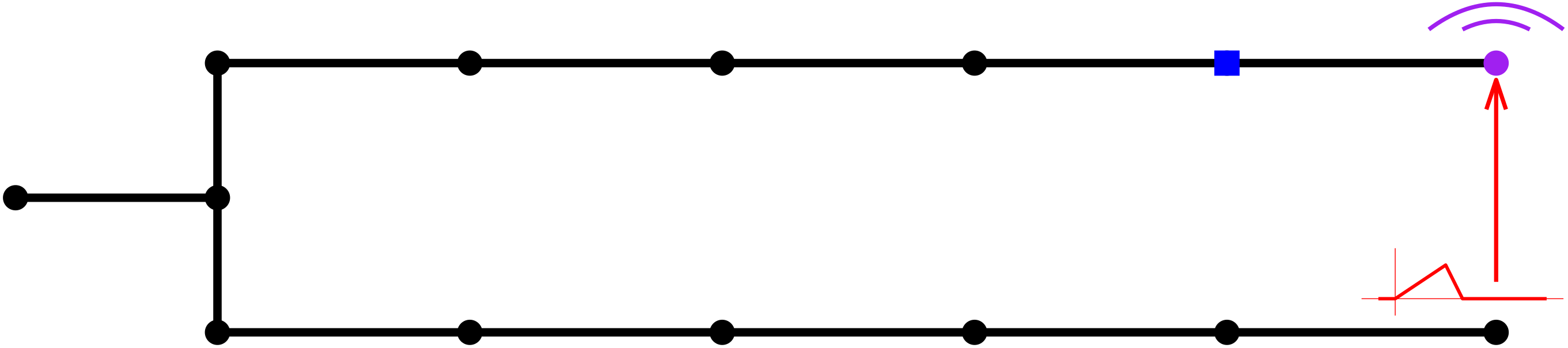
NB: In several places in this script, solve is called with optional verbose=false, because this script is part of the generation of Muscade's online documentation. Setting verbose=true would be more relevant in other contexts.
using Muscade, StaticArrays, GLMakie, Muscade.ToolboxDimensions of the tuning fork and number of elements
l₀=2.5e-2;  n₀=1    # base - length and number of elements
l₁=1e-2;    n₁=1    # fork - length and number of elements per side
l₂=9.5e-2;  n₂=5    # prong - length and number of elements per side
b = 5e-3;           # thickness of the cross-section
E = 210e9;          # Young modulus
G = 79.3e9;         # shear modulus
μ = 7850. *b^2;     # mass per unit length, assumes steel
beamCrossSection = BeamCrossSection(EA=E*b^2, EI₂=1/12*E*b^4, EI₃=1/12*E*b^4, GJ=1/3*G*b^4, μ=μ, ι₁=1/6*μ*b^2,Cl₂=10.,Cl₃=10.);
Define an A-parametrized point mass element (inducing an inertia force)
struct LumpedMass <: AbstractElement; m :: 𝕣; end
LumpedMass(nod::Vector{Node};m::𝕣) = LumpedMass(m)
@espy function Muscade.residual(o::LumpedMass, X,U,A, t,SP,dbg); return (o.m+A[1]).*∂2(X),noFB; end
Muscade.doflist( ::Type{LumpedMass})  = (inod =(1,1,1,2), class=(:X,:X,:X,:A), field=(:t1,:t2,:t3,:mass));
Time step and simulation length settings
Δt                = 3e-4;
nDynamicLoadSteps = 200;
timeVec           = Δt:Δt:nDynamicLoadSteps*Δt;
Coordinates of the nodes.
XnodeCoord = vcat(
    hcat((0:n₀) * l₀/n₀     , zeros(n₀+1,1) , zeros(n₀+1,1) ), # base nodes
    hcat(ones(n₁,1)*l₀      , (1:n₁)*l₁/n₁  , zeros(n₁,1)   ), # upper fork
    hcat(ones(n₁,1)*l₀      , -(1:n₁)*l₁/n₁ , zeros(n₁,1)   ), # lower fork
    hcat(l₀ .+ (1:n₂)*l₂/n₂ , ones(n₂,1)*l₁ , zeros(n₂,1)   ), # upper prong
    hcat(l₀ .+ (1:n₂)*l₂/n₂ , -ones(n₂,1)*l₁, zeros(n₂,1)   )  # lower prong
)
14×3 Matrix{Float64}:
0.0 0.0 0.0
0.025 0.0 0.0
0.025 0.01 0.0
0.025 -0.01 0.0
0.044 0.01 0.0
0.063 0.01 0.0
0.082 0.01 0.0
0.101 0.01 0.0
0.12 0.01 0.0
0.044 -0.01 0.0
0.063 -0.01 0.0
0.082 -0.01 0.0
0.101 -0.01 0.0
0.12 -0.01 0.0External excitation load at the end of the upper prong
@functor with() pling(t) = interpolator([-10, 0, 10e-3, 12e-3, 10],[0,0,10,0,0])(t)
plingNode = n₀+2n₁+n₂+1; # where do we hit the tuning fork
Building the model
model = Model(:TuningFork);Add the nodes describing the beam model, the node that will contain the parameter to optimize
Xnod = addnode!(model,XnodeCoord)
Anod = addnode!(model,𝕣[])Muscade.NodID(15)List of nodes that will be used to create the beam elements
nel = n₀+2n₁+2n₂
mesh = vcat(
    hcat(Xnod[1:n₀],Xnod[2:n₀+1]),                                                                              # base
    hcat(Xnod[n₀+1:n₀+n₁],Xnod[n₀+2:n₀+n₁+1]),                                                                  # upper fork
    [Xnod[n₀+1] Xnod[n₀+n₁+2]],         hcat(Xnod[n₀+n₁+2:n₀+2n₁],Xnod[n₀+n₁+3:n₀+2n₁+1])           ,           # lower fork
    [Xnod[n₀+n₁+1] Xnod[n₀+2n₁+2]],     hcat(Xnod[n₀+2n₁+2:n₀+2n₁+n₂],Xnod[n₀+2n₁+3:n₀+2n₁+n₂+1])   ,           # upper prong
    [Xnod[n₀+2n₁+1] Xnod[n₀+2n₁+n₂+2]], hcat(Xnod[n₀+2n₁+n₂+2:n₀+2n₁+2n₂],Xnod[n₀+2n₁+n₂+3:n₀+2n₁+2n₂+1])       # lower prong
)
13×2 Matrix{Muscade.NodID}:
NodID(1) NodID(2)
NodID(2) NodID(3)
NodID(2) NodID(4)
NodID(3) NodID(5)
NodID(5) NodID(6)
NodID(6) NodID(7)
NodID(7) NodID(8)
NodID(8) NodID(9)
NodID(4) NodID(10)
NodID(10) NodID(11)
NodID(11) NodID(12)
NodID(12) NodID(13)
NodID(13) NodID(14)In the XUA analysis we estimate the distributed load on the element close to the node where the load was applied
plingElement = n₀+2n₁+n₂;Add beam elements to the model, enabling Udof only for the element that is hit.
addelement!(model,EulerBeam3D{false}, mesh;             mat=beamCrossSection,orient2=SVector(0.,0,1))
[addelement!(model,Hold,[Xnod[1]]  ;field)  for field∈[:t1,:t2,:t3,:r1,:r2,:r3]];
Create variations of the model
XAmodel =   deepcopy(model)
XUAmodel =  deepcopy(model);
Add parasitic lump mass on both XA and XUA models
spuriousMass = 4e-3;
spuriousMassLocation = plingNode-1
addelement!(XAmodel,  LumpedMass, [Xnod[spuriousMassLocation] Anod]; m=spuriousMass)
addelement!(XUAmodel, LumpedMass, [Xnod[spuriousMassLocation] Anod]; m=spuriousMass);
Add known external force to X and XA models, and an unknown force to XUA model
addelement!(model,    DofLoad,[Xnod[plingNode]];field=:t2,value=pling)
addelement!(XAmodel,  DofLoad,[Xnod[plingNode]];field=:t2,value=pling);
@functor with(σᵤₚ=0.1) UcostPling(u,t) = 0.5*(u/σᵤₚ)^2 * clutch(t,0.02,0.04,1.,100.,1)
addelement!(XUAmodel, SingleUdof,[Xnod[plingNode]];Xfield=:t2,Ufield=:t2,cost=UcostPling)
Muscade.EleID(9, 1)Establish target response
initialState    = initialize!(model;time=0.);
dynamicStates   = solve(SweepX{2};initialstate=initialState, time=timeVec, verbose=false)
vibTarget       = getdof(dynamicStates;field=:t2,nodID=[Xnod[plingNode]])[1,:]
target          = interpolator(timeVec,vibTarget);
Add costs on the deviation to target measurements, in the XA and XUA models
@functor with(σᵥ=1e-6,target) Xcost(x,t)=((x-target(t))/σᵥ)^2
addelement!(XUAmodel,SingleDofCost,[Xnod[plingNode]]; class=:X, field=:t2, cost=Xcost);
addelement!(XAmodel, SingleDofCost,[Xnod[plingNode]]; class=:X, field=:t2, cost=Xcost)
Muscade.EleID(10, 1)Add costs on the correcting mass, in the XA and XUA models
@functor with(σₘ=5e-3,timeVec)          Acost_(a) = 0.5*(a/σₘ)^2/length(timeVec)
addelement!(XUAmodel, SingleAcost,[Anod]; field=:mass, cost=Acost_)
addelement!(XAmodel,  SingleAcost,[Anod]; field=:mass, cost=Acost_);
Run analyses
XA model (before estimating the mass)
XAinitialState    = initialize!(XAmodel;time=0.);
XAdynamicStates   = solve(SweepX{2};initialstate=XAinitialState, time=timeVec,verbose=false);
XA model (after having estimated the mass)
optimXAstate  = solve(SweepXA{2}; initialstate=XAinitialState, time=timeVec,
                maxAiter=20,maxΔa=1e-10,verbose=false);
DirectXUA (slack convergence criteria and number of iterations)
XUAinitialState    = initialize!(XUAmodel;time=0.);
optimXUAstate   = solve(DirectXUA{2,0,1};primerstate=[XUAinitialState], time=[timeVec],
                maxiter=15, maxΔx=5e-2,maxΔλ=Inf,maxΔu=5e-2,maxΔa=1e-4,verbose=false);
Gather results for comparison
analysisResults = (dynamicStates, XAdynamicStates,optimXAstate,optimXUAstate[end]);
t1 = Matrix{Float64}(undef,length(analysisResults),length(timeVec))
t2 = Matrix{Float64}(undef,length(analysisResults),length(timeVec))
t3 = Matrix{Float64}(undef,length(analysisResults),length(timeVec))
transmittedForce = Matrix{Float64}(undef,length(analysisResults),length(timeVec))
req = @request gp(resultants(fᵢ))
for idx ∈ 1:length(analysisResults)
    t1[idx,:] = getdof(analysisResults[idx];field=:t1,nodID=[Xnod[plingNode]])[:]
    t2[idx,:] = getdof(analysisResults[idx];field=:t2,nodID=[Xnod[plingNode]])[:]
    t3[idx,:] = getdof(analysisResults[idx];field=:t3,nodID=[Xnod[plingNode]])[:]
 end
excEstt2 = getdof(optimXUAstate[end];class=:U,field=:t2,nodID=[Xnod[plingNode]])[:];
Text output
println("Mass to remove in grams:")
print("- Estimated from DirectXUA analysis (unknown loading) : ")
println(-getdof(optimXUAstate[end];class=:A,field=:mass,nodID=[Anod])[1]*1e3)
print("- Estimated by SweepXA analysis (known loading) : ")
println(-getdof(optimXAstate[end];class=:A,field=:mass,nodID=[Anod])[1]*1e3)
print("- Expected : ")
println(spuriousMass*1e3)
Mass to remove in grams:
- Estimated from DirectXUA analysis (unknown loading) : 2.797022027613211
- Estimated by SweepXA analysis (known loading) : 3.999999036077599
- Expected : 4.0Plot the axial and lateral displacement of the control node, and the estimated force.
fig      = Figure(size = (1000,1000))
ax1 = Axis(fig[1,1],ylabel="Axial disp. [mm]")
lines!(ax1,timeVec,t1[1,:]*1e3,     label="Target",         color=:black, linestyle=:dash)
lines!(ax1,timeVec,t1[2,:]*1e3,     label="Detuned config.",color=:black, linestyle=:solid)
scatter!(ax1,timeVec,t1[3,:]*1e3,   label="Tuned (XA)",     color=:green, markersize = 10)
scatter!(ax1,timeVec,t1[4,:]*1e3,   label="Tuned (XUA)",    color=:red, markersize = 5)
axislegend(ax1)
ax2 = Axis(fig[2,1],ylabel="Lateral disp. [mm]")
lines!(ax2,timeVec,t2[1,:]*1e3,     label="Target",         color=:black, linestyle=:dash)
lines!(ax2,timeVec,t2[2,:]*1e3,     label="Detuned config.",color=:black, linestyle=:solid)
scatter!(ax2,timeVec,t2[3,:]*1e3,   label="Tuned (XA)",     color=:green, markersize = 10)
scatter!(ax2,timeVec,t2[4,:]*1e3,   label="Tuned (XUA)",    color=:red, markersize = 5)
ax3 = Axis(fig[3,1],ylabel="Excitation [N]")
lines!(ax3,timeVec,pling.(timeVec), label="Actual",color=:black, linestyle=:dash)
lines!(ax3,timeVec,excEstt2, label="Estimated (XUA)",color=:red, linestyle=:solid)
axislegend(ax3)

currentDir = @__DIR__
if occursin("build", currentDir)
    save(normpath(joinpath(currentDir,"..","src","assets","TuningFork.png")),fig)
elseif occursin("examples", currentDir)
    save(normpath(joinpath(currentDir,"TuningFork.png")),fig)
end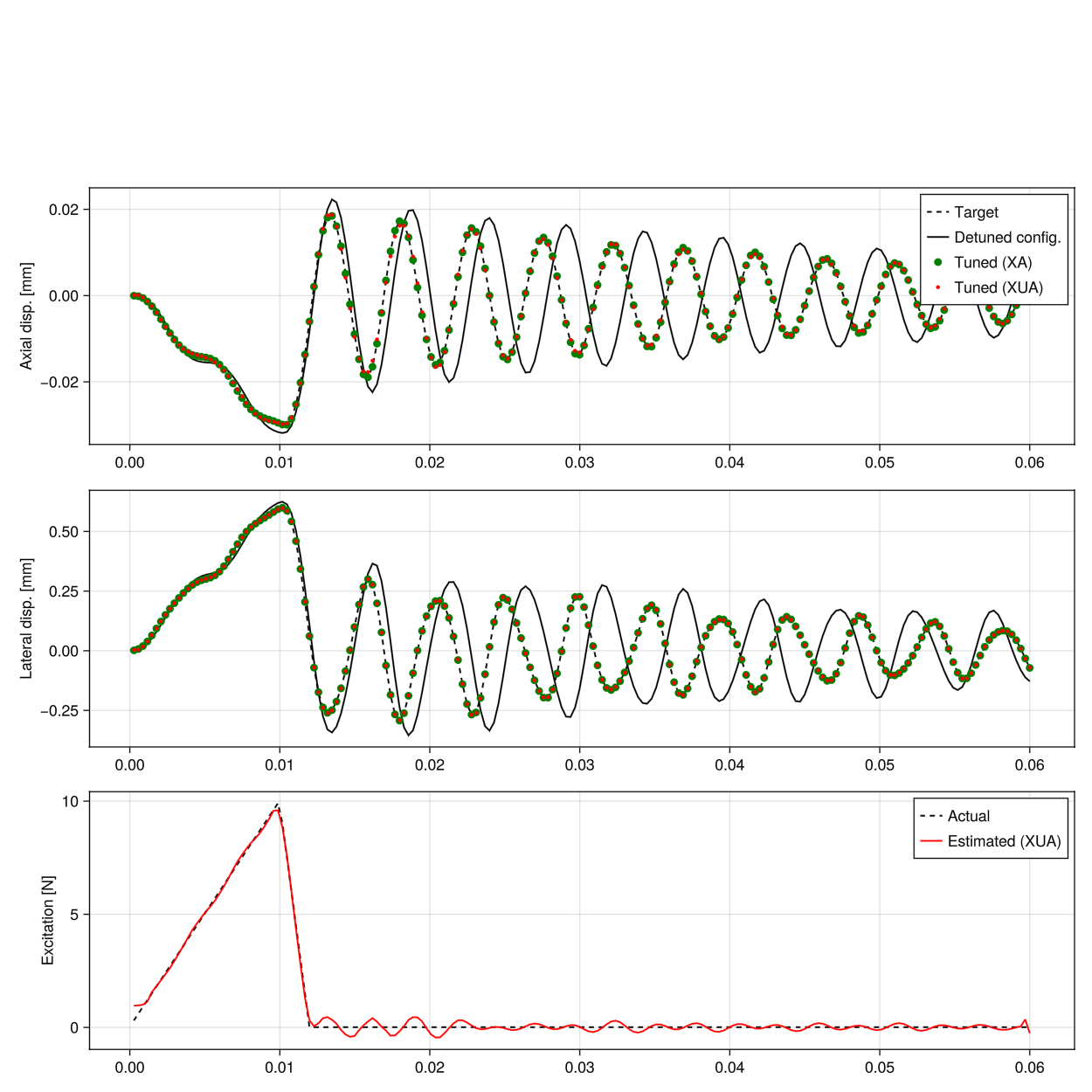
This page was generated using Literate.jl.